
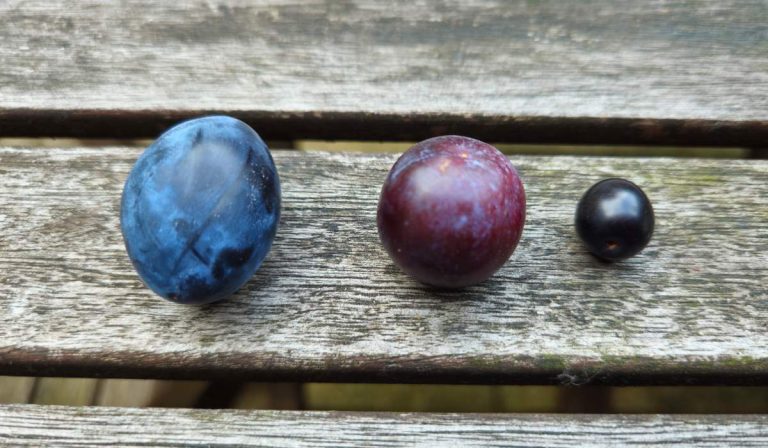
If you’ve ever found a blackthorn covered in dark purple fruit and wondered, “Are these sloes, bullaces or damsons?”, you’re in good company.
It’s one of those questions that comes up again and again in foraging groups every late summer and early autumn. And while the answer seems simple at first, things get rather more interesting when you look closely.
In this article, we’ll start with the simple rules that are genuinely useful in the field, then dig a little deeper into what you’re seeing, why these plants can be so confusing, and how much identification you really need.
A Quick Rule of Thumb
The usual advice to recognise the fruit is simple enough:
Small, round and blue-black = sloe.
Bigger, rounder and usually less astringent = bullace.
Larger, oval and plum-like = damson.
[Photo: From left to right: Damson, Bullace, Sloe]
For a quick identification in the field, these distinctions are a useful place to start. It’s easy to remember, gives you somewhere to start, and will often get you surprisingly close to the answer.
But wild plums make things less tidy. Look closely and you’ll find considerable variation in fruit, leaves, growth habit and even the plants’ thorns. Add cultivated forms and hybrids, and those three neat categories start to blur.
The botanical treatment doesn’t make things much easier either. Different sources have used different names and boundaries for these plants over time.
So let’s start with what you can actually see in the field, before getting into the more complicated botanical side of things.
The Three Familiar Fruits
The names we’re usually trying to separate are sloes, bullaces and damsons. All are closely related Prunus, and all can produce dark blue, purple or almost black fruit. They can overlap considerably in appearance.
Sloes
A genuine sloe is the fruit of blackthorn (Prunus spinosa). The fruit is generally small, round and blue-black, often with a noticeable waxy bloom.
Descriptions commonly put the fruit at around 10–12–15 mm in diameter. That makes size a useful clue, but not a magic number. If you’re finding fruits around 10 mm across, you’re in typical sloe territory. Larger than that, don’t simply assume you’ve discovered a giant sloe, as we will see later.
The leaves are another useful character, but there’s a trap here. People often concentrate on the tip of the leaf, expecting it to be either pointed or blunt, but it isn’t that simple.
The leaf tip can vary, and blackthorn generally has relatively small leaves, commonly around 2–4 cm long. They have an elliptic to obovate or oblanceolate shape.
And then there is the feature that gave blackthorn its name. Blackthorn is a thorny shrub, often forming dense, tangled thickets with dark twigs. But even here, not only an actual blackthorn can have thorns, as we will see later.
Its flavour is intensely astringent, making them suitable only for cooking or infusing.
Damsons
Damsons are generally the largest of the three, with fruit that is slightly oval rather than perfectly round. They can be around 2–3 cm across, depending on the variety. They can have dark blue or purple skins and yellow-green flesh. Compared with a typical sloe, they can look enormous.
When fully ripe, they can be perfectly edible straight from the tree and have a gently sweet-tart flavour. Pluck one and give it a gentle squeeze. It should feel plump rather than mushy. If it yields slightly and carries a faint fragrance, it is likely to be ripe.
They grow on large shrubs or small trees, often forming thickets with tangled, crossing branches and slightly toothed leaves. From a distance, the fruit can look remarkably like small purple plums.
The name damson, however, isn’t quite as straightforward botanically.
Damsons are commonly associated with Prunus insititia, which Kew currently treats as an accepted species. Kew also lists Prunus domestica subsp. insititia as a synonym. The RHS likewise uses P. insititia for damson and lists bullace among its common names.
Older British botanical treatments placed P. insititia within P. domestica as subsp. insititia, which helps explain why you’ll find both names in different books.
There is also considerable variation between individual damson trees and cultivated varieties, so fruit size and shape aren’t enough to identify every damson.
Bullaces
Bullaces are where things start getting properly awkward.
Traditionally, the name has been used for forms of Prunus insititia with relatively small, round fruit. In the field, however, a bullace is usually something that looks rounder and generally smaller than a typical damson.
You could also think of it as a bigger, rounder cousin of the sloe, although that description is much tidier than the plants themselves. And this is where the boundaries start to blur.
Bullaces can vary considerably in size, colour and flavour. Some are sweet, some are sharp, and some can be extremely astringent. Yellow or golden bullaces can be surprisingly sweet, while others can taste almost as sour as a sloe.
The terminology doesn’t make things much easier either. Older British treatments may place bullaces alongside damsons under P. domestica subsp. insititia, while modern treatments may use P. insititia instead.
So in practice, “bullace” is often more useful as a description of the fruit you’re looking at than as a perfectly precise botanical category.
This is why taste can be useful, but only once you’ve established that you’re dealing with an edible Prunus and are confident about what you’re tasting in the first place.
The Hybrids
This is the bit that often gets left out.
There are cultivated damsons, domestic plums, bullaces, damson-bullace forms and other plants that don’t fit comfortably into three neat boxes. The terminology becomes particularly confusing because botanical authorities don’t always use the same classification.
One example is Prunus × fruticans, a recognised hybrid between P. insititia × P. spinosa. In other words, there are plants that sit somewhere between the insititia group and blackthorn, rather than fitting neatly into one of the familiar categories.
That helps explain why you can sometimes find a plant that looks partly like a blackthorn, partly like a bullace and partly like a damson.
The Problem with Hybrids
The trouble is that hybrid plants don’t necessarily come with a neat 50/50 mixture of characteristics.
Some intermediate plants are relatively small and shrub-like, while others can become surprisingly large. Some retain obvious blackthorn characteristics such as strong thorns, while their fruit may be considerably larger than a typical sloe.
That is why “it has thorns, therefore it’s a sloe” doesn’t always work.
The more complicated forms of Prunus can contain a mixture of characteristics inherited from different plants. Add repeated hybridisation and cultivated forms, and the boundaries become even less obvious.
This is one reason why technical descriptions and internet identification guides can sometimes appear to disagree. A plant may genuinely sit somewhere between the descriptions they’re using.
How Much Identification Do You Actually Need?
This is worth asking. While we’re mostly hobbyist foragers and not expert botanists, I think a large part of the enjoyment of foraging comes from knowing exactly what you’re eating.
There is something satisfying about finding a plant, noticing its characteristics, working out what it is and then discovering how its flavour compares with another tree growing half a mile away.
For everyday foraging, you don’t necessarily need to determine the precise botanical ancestry of every dark purple plum you encounter. But you should still be confident that you’ve correctly identified the plant as an edible Prunus before eating it.
Once you’ve done that, you can decide how much further you want to take the identification.
You might simply want to know whether the fruit is likely to be intensely astringent or pleasantly sweet. You might want to distinguish a typical sloe from a bullace. Or you might become fascinated by the awkward plant growing in your hedge that seems to have characteristics of three different things.
That’s where foraging gets interesting.
The Important Lesson
The more you learn about these plants, the less useful the original question becomes on its own.
The better question is:
“What characteristics does this particular plant have?”
That shift is useful far beyond Prunus.
Good plant identification isn’t about memorising one picture or one defining feature. It’s about learning to notice.
Look at the fruit, the leaves, the twigs, the scale and the stone. Taste it when appropriate. Then put all those observations together.
You may not always arrive at a perfect botanical name, but you’ll become a much better forager. And that’s ultimately more useful than winning an argument in a Facebook comment section.
One Final Caveat
I’m not a specialist botanist, and this article isn’t intended to provide definitive botanical identification of every wild Prunus.
My aim is more practical.
I want to give you a quick rule-of-thumb approach for recognising the plants you encounter, understanding their variation, and knowing what you’re actually picking.
If you’re trying to establish the precise identity of a difficult or unusual plant, especially for a botanical record, you’ll need much better evidence than a photograph of the fruit alone.
That means clear photographs of the fruit, leaves and twigs, measurements, and ideally the cleaned and dried stone from more than one angle.
Because with Prunus, sometimes the most honest answer isn’t “It’s definitely a damson.” It’s: “There’s more going on here. Let’s have a proper look.”


2 thoughts on “How to Identify Damsons, Bullaces and Sloes”
Hi
I’m presently writing a book on the European plum Prunus domestica and read your article on the three Prunus species you forage for, I found it quite interesting and explanatory.
I would like to use your picture of the three Prunus species on the bench if I may, as it would highlight the section on this clade of Prunus I’m writing about, to show the close relationship of P, domestica, subspecies, insititia var, nigra and P. spinosa have to P. domestica L
Hi Philip,
I’ve just sent you an email in response to your request.
Alvaro