
Silverweed: Plant profile
Common names
Silverweed, Silver Weed, Common Silverweed, Cinquefoil, Briosclán (IE)
Botanical name
Potentilla anserina (syn Argentina anserina)
Plant family
Rosaceae
Distribution
Native throughout the temperate Northern Hemisphere. Very common throughout the UK and Ireland.
Where to find Silverweed
Grassland, wasteland, meadows and riverside.
When to find Silverweed
Roots in late summer and autumn. Leaves spring to autumn.
How to identify Silverweed
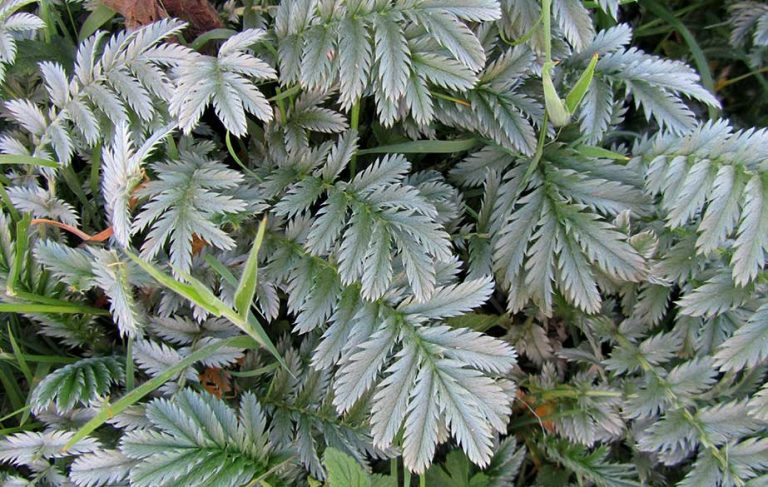
Silverweed is a perennial creeping, trailing plant growing up to 30cm in height. The leaves are compound, with many oblong, serrated leaflets. They are wooly and silvery-green in colour. The flower is yellow, have five petals and grows on a leafless stalk between June and September.
Silverweed lookalikes
It could be confused with other related plants Potentilla sp. such as Creeping Cinquefoil (Potentilla reptans).

All about Silverweed
The leaves are what give rise to this plant’s name, which are a distinctive silver-green on the topside and coated of silvery grey fine hairs on the underside. This makes silverweed unique and easy to find amongst the grasses.
Medicinal properties of Silverweed
The entire plant is antispasmodic, mildly astringent, diuretic, and haemostatic.
It’s said the leaves can be placed in shoes to absorb excess sweat because the starch content helps absorbing moisture.
Culinary uses and recipes with Silverweed
All parts of silverweed are edible, though the flavour and texture of the leaves is not particularly attractive. They still can be tossed into salads or made into an herbal tea.
It’s the roots that are of main interest due to its starch content. However they have been long considered famine food because they are fiddly to collect, so small to use and hard to clean. They can be dried and ground into a powder to use in soups and stews.
The flavour is good, crisp and nutty with a pleasant starchy flavour, similar to Jerusalem artichokes. Apparently, at some point the roots were boiled or baked, sometimes dried and ground into flour to make bread.

Safe foraging of Silverweed
Some sources cite possible stomach irritation in certain individuals.
Ecological importance of Silverweed
The flowers provide a nectar source for bees, particularly the honeybee.


6 thoughts on “Silverweed”
My son is a forager and Chef, and he has turned me into a critic, to people who call lots of plants weeds. As he combed our backyard on a walk one day he pointed out many plants that people spend lots of money killing. He went on to tell me what was edible and what was quality edible, it was amazing! So this summer when I was trying to cover a hillside, that I never wanted to mow. I went to a local nursery that specializes in native plants and one of the plants that they recommended was Silverweed. What a great choice. It’s spreading all across the hill in and out of the clover that I planted to keep from the hill eroding. I haven’t used it yet for a culinary ingredient or for medicinal purposes, but plan to in the future. Thanks for your interesting article to educate me more about the Silverweed.
Hi Benny. Thank you for sharing your wonderful experience. It’s inspiring to hear how your son has turned your backyard into an herb garden. I hope you enjoy experimenting with all of these amazing herbs!
My grandparents immigrated to Canada from Switzerland and they told us about this little plant. They told us that farmers there would give this to calves or piglets if they got scour’s animal diarrhea and instead of dying they would recover. They then decided to make a tea from it to see if it could help people as well and it sure did. I have been picking this plant , just the leaves to dry and make a medicinal tea since I was in my teens. My daughters said that it also helped them with their menstrual cramps. I planted some in my flower bed so we don’t run out of it.
Hi Randy,
Many thanks for sharing your beautiful story. Good to see plant traditions passing through generations, even after living in different countries!
thanks for this informative website. Researching Silverweed for an Art tutorial… I like to give little details especially foraging, during the class.
thank you :O)
This site is so useful