
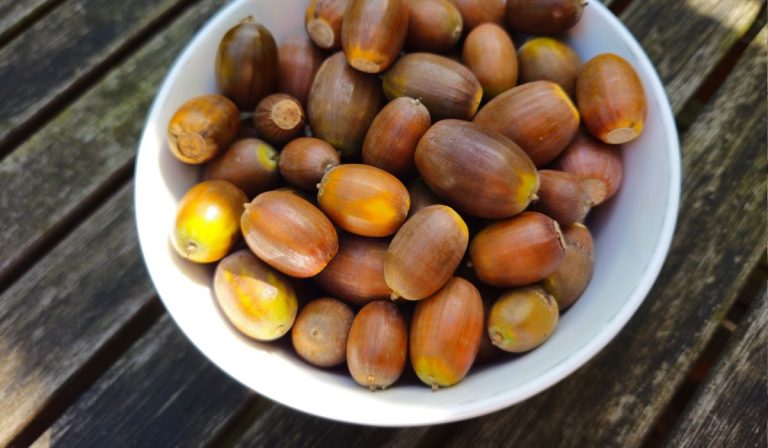
Acorns often fly under the radar in the foraging circles. We tend to think of them as food for squirrels, yet people have eaten them for thousands of years. They are rich in starch and can be turned into flour, meal, porridge, cakes and other foods.
The reason you cannot simply crack one open and eat it is tannins. Raw acorns can be intensely bitter and astringent, so they need to be properly prepared before eating.
Fortunately, the solution is simple: leaching. By repeatedly soaking acorns in fresh water, or boiling and changing the water, you can remove much of their tannin and turn them into a useful wild food.
How to Gather Acorns
Acorns generally ripen in Britain from late summer into autumn, with September and October being particularly useful months for gathering. The exact timing varies with location, weather and species.
Look for mature, firm acorns that are beginning to turn brown and are naturally falling from the tree.
The best acorns are free from obvious holes, mould, cracks or signs of insect damage. A hole in the shell is a good reason to discard one. You can also test a batch by placing the acorns in water and removing those that float, although this is not a perfect test and should not replace inspecting them individually.
There is no need to insist on picking directly from the tree. Fallen acorns can be perfectly good food. The important thing is to gather them promptly and sort them carefully, because acorns lying on the ground are more exposed to moisture, insects and mould.
What Acorns To Choose
In Britain, English oak (Quercus robur) and sessile oak (Quercus petraea) are familiar and readily available choices. Their acorns can be eaten after appropriate preparation.
Other non-native oak species can also produce edible acorns. What varies considerably between species, and even between individual trees, is their tannin content. Some acorns are naturally much more bitter than others.
That difference matters because it affects how much leaching they need.
Why Acorns Need Leaching
The main reason for leaching acorns is their tannin content.
Tannins are naturally occurring compounds found throughout the plant kingdom. They contribute to the dry, puckering sensation you experience when drinking strong tea or eating some unripe fruits.
In acorns, tannins make the raw nut unpleasantly bitter and astringent. They are also part of the tree’s natural chemical defences.
Leaching works by allowing these water-soluble compounds to move out of the acorn and into the surrounding water. Repeatedly replacing the water gradually reduces the tannin content.
The aim is not to remove every trace of tannin. It is to process the acorns until they are pleasantly mild rather than strongly bitter or astringent.
This is why the taste of the acorns matters. If they still taste distinctly bitter, keep leaching.
Two Ways to Leach Acorns
There are two main approaches: cold-water leaching and hot-water leaching.
Both work on the same basic principle, but they produce slightly different results.
Cold Leaching: This method is slower but particularly useful if you want to make acorn flour. Because the acorns are not cooked during the leaching process, their starch remains largely uncooked. This can be useful when incorporating acorn flour into bread and other baked foods. The trade-off is time. Depending on the acorns and how finely they are prepared, cold leaching can take several days rather than a fixed one or two days.
Hot Leaching: This method is considerably quicker. The acorns are boiled and the tannin-rich water is discarded before fresh water is added. This is repeated until the acorns have lost their strong bitterness. The resulting acorns are suitable for eating, grinding or incorporating into cooked dishes. However, because they have already been heated, their texture and starch behave differently from cold-leached acorns.
Neither method is inherently better. Choose the method according to what you want to make. Before either method, you will need to shell the acorns.
Cold Water Leaching for Acorns
Cold-water leaching is wonderfully simple. It just requires acorns, water and patience.
1. Shell the acorns
Remove the hard outer shells. Discard any nuts that are mouldy, badly damaged or show obvious insect infestation. You can remove the thin brown skin from the kernels too. It is not essential, but removing as much as possible can produce a cleaner-looking flour and may help reduce some bitterness.
2. Chop or grind the acorns
Break the kernels into smaller pieces, or grind them into a coarse meal. The smaller the pieces, the greater the surface area exposed to the water, which generally makes leaching more efficient.
3. Cover with cold water
Place the prepared acorns in a bowl or container and cover them generously with cold water. Leave them to soak, then drain and replace the water regularly. There is no magic number of water changes. Some acorns lose their bitterness relatively quickly, while particularly tannic batches can take considerably longer.
4. Keep changing the water
Change the water several times a day where practical. As the tannins leave the acorns, the water can become increasingly dark. Continue replacing it until the acorns have lost their strong bitterness and astringency.
Taste a small piece from the batch as you go. The finished acorns should taste mild and nutty rather than strongly bitter or mouth-puckering. Keep the soaking acorns cool and use clean containers and fresh water to reduce the risk of spoilage.
5. Drain and dry
Once properly leached, drain the acorns thoroughly. You can then use them fresh, or dry them before grinding into acorn flour. For baking, the dried meal can be ground into a finer flour and used on its own or mixed with wheat flour and other ingredients.
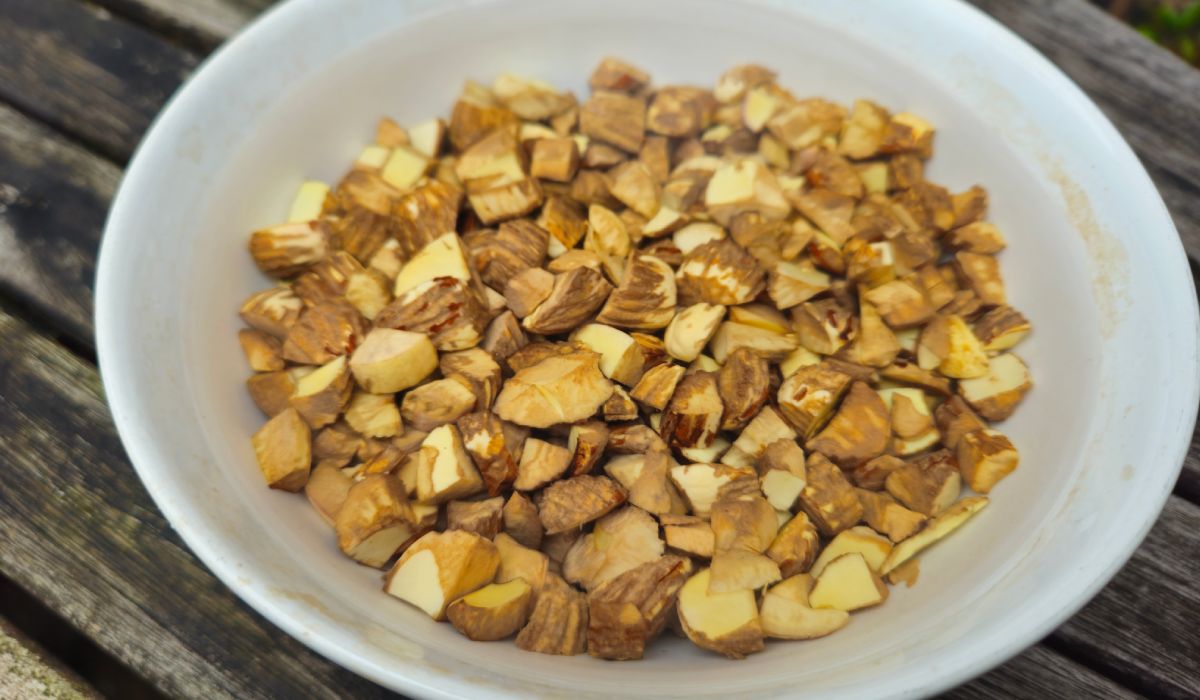
Hot Water Leaching for Acorns
Hot-water leaching speeds the process up considerably. The basic principle is simple: boil, discard the water, add fresh water, and repeat.
1. Prepare the acorns
Shell and inspect the acorns as above. You can leave them whole, chop them into smaller pieces or grind them into coarse meal. Smaller pieces will generally leach more quickly.
2. Boil the acorns
Place the prepared acorns in a pot and cover them generously with water. Bring the water to a boil, then maintain a simmer. As the acorns cook, the water will often become dark brown as tannins move into it.
3. Discard the water
After boiling for a while, drain the acorns thoroughly. Do not use the discarded water. Add fresh water and bring the acorns back to the boil.
4. Repeat
Continue boiling, draining and replacing the water until the acorns have lost their strong bitterness and astringency. The exact number of changes will vary. Some batches may need only a few, while others may require considerably more. There is no advantage to rushing this part.
One important point: you do not need to add salt, and you do not need to plunge the acorns into cold water between changes. The important thing is to remove the tannin-rich water and replace it with fresh water.
Storing Leached Acorns
Freshly leached acorns contain a lot of moisture, so they need to be treated as a perishable food.
-For short-term use, keep them refrigerated and use them promptly.
-For longer storage, dry them thoroughly before storing. They can also be frozen once properly prepared.
If you are making acorn flour, drying the leached acorns thoroughly before grinding is particularly important. Moisture left in the flour can encourage spoilage. As with any wild food, discard anything that develops mould, an unpleasant smell or other obvious signs of deterioration.
Is Leaching Acorns Worth the Effort?
You might look at the process and wonder why anyone would bother. After all, the supermarket is full of food that requires considerably less preparation. But that is missing the point.
Acorns are not a convenience food. They ask you to slow down. You have to notice the oak tree, wait for the right season, gather the acorns, sort them, shell them and then patiently turn them into something edible.
That process is part of the food.
And there is something satisfying about taking an ingredient that most people walk straight past and turning it into something you can actually eat.
Acorns are also remarkably versatile. Properly prepared, they can become flour, meal, porridge, cakes, breads and savoury dishes, with a rich, nutty flavour that is quite unlike ordinary grain flour.
So yes, leaching acorns takes effort. But perhaps that is exactly why they are worth learning about. The reward is not simply another wild ingredient. It is the knowledge that an abundant autumn crop beneath your feet can become food with a little attention, patience and skill.
And once you have leached your first batch successfully, the next autumn becomes a little more interesting.

36 thoughts on “A Forager’s Guide to Leaching Acorns for Safe Eating”
Why must acorns be dried before leaching? To prevent mold?
Hi Joanne, I meant that acorns will dry quicker after leaching if broken into small pieces, in case you intent to use them as ground coffee substitute. Also, you can dry them immediately if you don’t have the time to leach them immediately after picking, as otherwise they’d become mouldy.
I leached my acorns in hot water for like 7 hours but the water I put them to boil in was never clear. They’ve boiled dark the whole time and are dark brown and like squishy, I tried it but there’s no bitter taste. Why isn’t the water running clear? I was especially careful to not let them touch cold water or even cool down and was routinely boiling them for hours
Hi Amira, It’s difficult to say from your comment, but I wonder whether you have been changing water during that time? Anyway, as long as they don’t taste bitter, that means you have removed most tannins from the acorns
I think you have to simmer the acorns 15 to 30 minutes each time you replace the water with fresh hot water like 3or4 times until it stops turning brown. I think you over cooked them
H llo, I recently tried cold leeching a batch of white oak acorns (sawtooth) that I collected back in October, it it is now May and I started a week ago in April. I also used baking soda and the results seemed to be really good at first. Initially, I soaked them over night with the shell to soften them up and the shelled them with a large mortar and pestle, that worked fantastic! Then I cut each one in half. As I was cutting them I noticed that some were starting or had been sprouting. I kept the sprouted acorns, but I was sure to toss any that floated to the top. I however, left the ones that sort of hoovered over the bottom of the bowl. I kept clearing out the water two or three times a day at first. After several days, I started to only change the water on e or twice. I started noticing darker spots on the shells, but I assumed I was just getting the last of the really deep, rich tannins out. One day I went to my sister’s to do some morel hunting and the entire batch turned really dark like walnut dark. I was concerned about contaminating my dehydrator so I’ve had them drying Infront of a fan for a day or so two now. Of course, they are still black. Should I throw them out, make it out of them, dry them really well in the decorator and use them somehow, or squirrel food or fertilizer, or compost or what? I don’t know, but I spent a lot of time collecting them and don’t want them to go entirely to waste. I’m thinking of trying to make an acorn ink out of them like I did with my walnuts. What do you think?
Hello Andy,
It’s difficult to judge anything without seeing it, but as a rule of thumb, if something doesn’t look right, ir probably isn’t. I know it’s a lot of effort put into cold leaching, but the only way to learn how to do something is making mistakes. Just learn from the experience and toss it to the compost pile, though I guess the ink idea is worth giving a try too. That’s something I never tried before.
I have a Lot of acorns to process, and would like to do this over several months. I’m afraid the acorns will mold and allow the little worms to mature within the shell. I’ve tried to dry them inside my house, spread out in containers. When I went to remove the shells to process them I noticed some were moldy and at the bottom of the containers were several little worms.
I tried drying them in the oven at 175 degrees Fahrenheit for an hour. The temperature was high enough to kill the worms and stop them from molding, but when I removed the shells the meat smelled sweet and a little like maple syrup. I’m guessing this began the hot leaching method and the flour would need a binder to use it for baking. Also I don’t think I can store these acorns and would have to process them as soon as possible or they would spoil.
That leaves me with one other option and that would be to use a method of drying where the temperature goes no higher than 105 degrees Fahrenheit. Is this true? Doing it outside isn’t an option I’m in north east United States (Maine), and it’s getting cold and rainy.
I’m going to try dehydrating them using a dehydrator in order to store them for processing them later, I just want to make sure this method will preserve them. I’m guessing the acorns would need to be stored in a cool, dark, and dry environment. On a funny note I remember my father stored walnuts he gathered in our attic to find out later squirrels found there way inside and looted all of them. We was pretty mad..
I wonder what type of oak trees I have. A web sight said acorns are either white or red. I’m certain mine are red acorns since they have a thicker shell and have a fuzzy membrane over the nut meat inside. This membrane cannot be removed entirely so I’ll try your method of boiling them with salt for 30 minutes. Is there another way to remove the skin using the cold leaching method?
Hi Christine,
Perhaps a bit long to answer in the comment section, so I’ll try my best:
-Worms can be avoided if acorns are submerged in water. Those with worms will float.
-Mouldy acorns means improper storage and excess humidity. Best stored in breathable bags, such as hessian or similar and dried as soon as possible.
-After one hour in the oven at a high temperature your acorns have been cooked.
-In cold and rainy UK, I just dehydrate them in the radiators indoors. You can also use a dehydrator.
-Consider alternative preserving methods such as pickling, freezing or making a spread similar to the French ‘Crème de Marrons’.
-The skin can be removed by leaving the acorns 5 minutes in hot water, just like you’d do with almonds.
What if you have boiled the nut for 15 minutes about 8 times and the water is still brown but the nut is not bitter? Is it safe to eat?And I did put them in cold and warm water between boilings, over a period of about 24 hours. Also, if you do the cold water soak or the boil should we use purified water? There is chlorine in our tap water in USA.
I have just tried leeching my acorns
Cut them in halves. They have all turned a brownish colour. Is this normal.
Also what is best way too store unshelled acorns over winter
Hi Nigel,
The water gets brown because the tannins are released into the water, which is normal. (Don’t forget to remove the brown skin first! Otherwise they’d become very bitter).
Unshelled acorns can be dehydrated in two ways: either leaving in the sun for a few days or in a dehydrator / radiator, separated in a single layer, until they sound a bit hollow in the inside. Them, they are ready to store for thw winter months.
I collected acorns from an English oak in October, chopped them up into small bits, have been leaching them in cold water ever since with 2-3 water changes per day, and they are still bitter. Did I miss the window and they’ve gone bad? Or is more time still needed? Please advise!
Hi Katie,
It’s difficult to tell what’s going wrong, it could be a lot of things! Did you remove the outer brown skin before submerging in water? Did you let the acorns stagnate in water for a day at some point? Were the pieces small enough? Could that be a different oak species?
This process normally takes 1-2 weeks, but leaching them for months seems a bit too much, so perhaps they got spoiled?
Bear in mind that they will never become sweet after cold leaching, as the process just removes the bitter tannins. It’s after baking with the flour that they release natural sugars and become sweeter.
Greetings, Mr. Dock. Thank you for the time and effort you have put into this article.
I found myself with some less-than-stellar acorns this year. After drying and shelling, I find most are stained a dark brown to black. I assume this is (are?) tannins from the shells and am cold leaching them. Most of the color is coming out. Should I continue to leach the nut halves until the the water remains clear or stop when no bitterness is detected?
FYI: this is a for fun project. If nothing else I will leach, dry, and feed them to the squirrels. Thank you.
Hi Joe,
Acorns should not be black after dried, I am concerned they might be mouldy, perhaps?
Generally, acorns dye water into a brownish colour and you should continue to leach until the water remains clear, ideally when no great deal of bitterness is perceived.
If unsure, squirrels will appreciate them anyway. 😉
Have a nice day!
Very well could be mold. They’ll be going to the squirrels then. Thanks!
Hi!
Okay, I have been collecting my acorns over the past two or three weeks….. and guess what?…I am reading your article, Alvaro, and trying to decide which leaching process to choose….only to discover that half of my acorns have now sprouted! Is it still worth having a go? And if so, which process would you try? Hot water?
Hi Lesley,
Acorns change internally once they have sprouted. Starch turn into sugars, the texture becomes more rubbery and the nutrients change.
They can still be processed and eaten, but the result will not be the same as for just ripen acorns.
I would go for hot leaching and enjoy them as snacks, pickles or in soups, just because I think cold leaching for flour is not worth trying in this case.
Hope it helps,
Alvaro
Have you ever tried Oak leaf wine?I made it and it tasted very good.I take it that the tanins in the leaves gave it the body that a white wine needs.It didn’t require the the same process of boiling like Acorns do.I boiled the leaves first to extract the flavor.
Hi Richard,
I have never tried oak leaf wine, though it sounds like a good idea. I guess it can be used as a shortcut to storing the liquid in oak barrels while resulting in a slightly different profile.
Hello! I’m learning to leach acorns as a surprise for my mother. She has several trees at her new house but has no idea what to do with them. Does any one know how long after hot leaching and then roasting that they would stay good? I’m trying to time it to go with her Christmas this year! Thanks in advance!
Hi Emma,
It may depend on the particular acorn species and other factors.
Generally, you’d expect something in between 2 to 4 changes of water.
Try one piece everytime you change them and you’ll find out when they are ready.
Hello,
I am using a new hot leaching method that includes adding baking soda to the water to speed up the leaching process.
The comment on the other website where I saw that didn’t spell out the reasoning, but I’m guessing that changing the chemistry of the leaching water draws the tannins out faster by binding to them. This appears to be working beautifully, as I am only on the third boil, and this one may actually not be necessary! I filled up the pot this time before I tasted the nuts, since I am used to having to do many more boils. The boiled acorns have turned dark, but are not bitter at all now.
For the first time however, I noticed that there are little droplets of what I think is acorn oil on top of the leaching water. Perhaps that was happening before, and I just failed to notice it. Your website mentioned that the hot process will leach out acorn oil with the tannins. Am I losing nutrients by doing that?
Your site also states that if I use hot process leaching to make flour, I will need to add a “binder.” This is the first I’ve heard of that. What is a “binder,” as the word is used here? Please give an example of an additional ingredient and process in acorn bread making, since that’s what I leach the acorns for.
I always use the hot process, both for speed and because I don’t have a stream or easy access to a flowing water source. I once had an unattended small batch go bad as you described when I put them in a bucket of cold water and forgot about them.
Since I know that the acorn shells have tannins as well, I thought about concentrating them for use in a friendlier skin tanning operation. Oak bark is non toxic, as opposed to the current high tech method metals method, which is massively environmentally polluting. Research has shown that the old oak skin tanning method requires 120 pounds of powdered oak bark per cowhide, and that’s a lot of dead oak trees!
Since stripped, dead oak trees is almost as bad a result as commercially poisoned water, I’d like to make a suggestion for the photographer who asked about concentrating tannins, even though he’s using it as a photo fixer and not to tan hides.
Shell the acorns, and put them in a large tub of water outside, either cold processing or over a fire, hot processing them. Process the acorn meats separately for consumption, and throw the wastewater into the acorn shell processing bath so you’re adding the nut tannins to that. No waste! either boil of the water or allow the Fall sun to evaporate the excess water, which would concentrate the tannins. Once you have the proper concentration, you’d have photo fixer, or in my case, non tree killing, non metal toxic skin tanning solution.
I know this is a lot for one comment, but I look forward to seeing what you have to say on all of my points, starting with the acorn oil / nutrition /binder issue, which for me is the most important of the questions.
Hi Laurie,
-Never heard about using baking soda, but I am sure I will try.
I still have a batch waiting for processing.
-Hot leaching will remove the oil with the tannins and therefore reduce the nutrition that comes from the fatty acids. On the other hand, your flour would last longer, because a high oil content can make it rancid over time.
-However acorn flour should be made from cold-leached acorns, otherwise the heat would cook the starch. You need this starch to form a cohesive mass made from the flour, water and oil so you can shape your dough. If you use hot-leached acorn flour I would recommend you add regular wheat flour in the mix to help shape your dough. It will still retain the sweet nutty flavour of acorn bakes and the flour will go a long way.
-I really appreciate your advice on the tanning solution, which I am really sure will be of big use to the poster below.
Hi Alvaro
Are acorns from all varieties OK to eat or are there some to avoid – most seem to be quercus robur where I live in Switzerland ?
Hi Christopher,
All acorns are edible after leaching, but some taste better than others.
Quercus robur and Quercus petraea are the ones I normally use.
Hi!
I would like to leech out the tannins and use the tannin infused water as a toner in an alternative photography project, therefore I would like quite a heavily infused tannin water. Are there tannins present in the shell/skin or should I just use the inside part? Time isn’t an issue so I don’t mind doing either the cold or hot method, but which is likely to remove the most tannins and then retain the tannins in the water ? I imagine grinding or breaking the acorns prior to leeching would be the most thorough way to extract the tannins?
Hi Mark,
I have never used tannins as a natural ink, so I am not sure about the best procedure.
Tannins are present in the wood, bark and acorns of oak. For you purpose, I would soak the organic material in water for as long as possible.
You might also consider using unripe walnuts or tea leaves, which also contain high levels of tannins.
Hi Mark,
The comment from Laurie S. above might help you with your project, just have a look.
I really want to do acorn flour. But l’m a bit scared of poisoning myself and damaging my kidneys. Advice please.
Hi Geri,
Acorns are totally safe as long as you follow leaching instructions, the same way you should not eat uncooked butter beans or raw potatoes.
There is no reason to be scared. You can even eat a raw acorn or two with no ill effects. However they are so bitter when unprocessed that you will not want to anyway!
I want to eat them as nuts. Which leaching method is the best? Hot or cold?
Hi Nicky. Acorns eaten as nuts are naturally sweet but those rarely grow in the UK. If you still want to eat them as nuts and you cannot find the right species, I would recommend roasting them in the oven after leaching. The method is up to you. Generally speaking, hot leaching is quicker but the result will be a bit mushier. Cold leaching is very slow as it can take days, but you will get the crunch.
Hi!
I have made mock coffee after following a blog. It suggested you could boil the acorns with the shell on for 20 mins to remove tannins.
Then cool, shell, dry for 24 hours, chop and roast.
Is this okay? Or will there still be tannins in the acorns using this method?
Olivia.
Hi Olivia, generally the more times you boil the acorns, the less tannins will remain. Try boiling without shell and will work faster. Hope it helps