
Goldenrod: Plant Profile
Common names
Canadian Goldenrod, Canada Goldenrod, Golden Rod
Botanical name
Solidago canadensis
Plant Family
Asteraceae (Daisy)
Distribution
Native to north-eastern and north-central North America. Invasive plant in many parts of Europe, Japan and China. Widespread in England, less so in Wales, Scotland and Northern Ireland..
Where to find Goldenrod
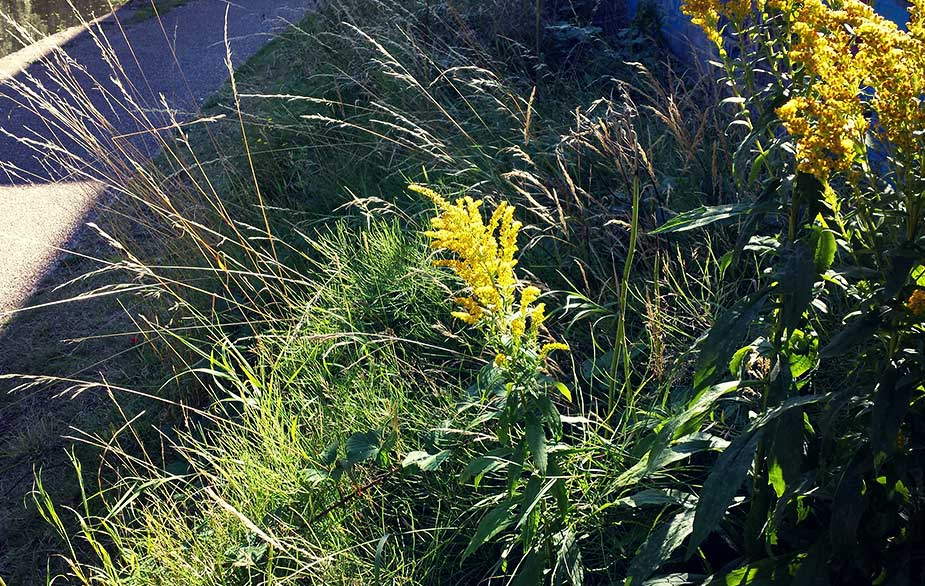
Wasteland, grassland, roadsides, riverbanks and canalsides.
When to find Goldenrod
Leaves spring and blossom late summer.
How to identify Goldenrod
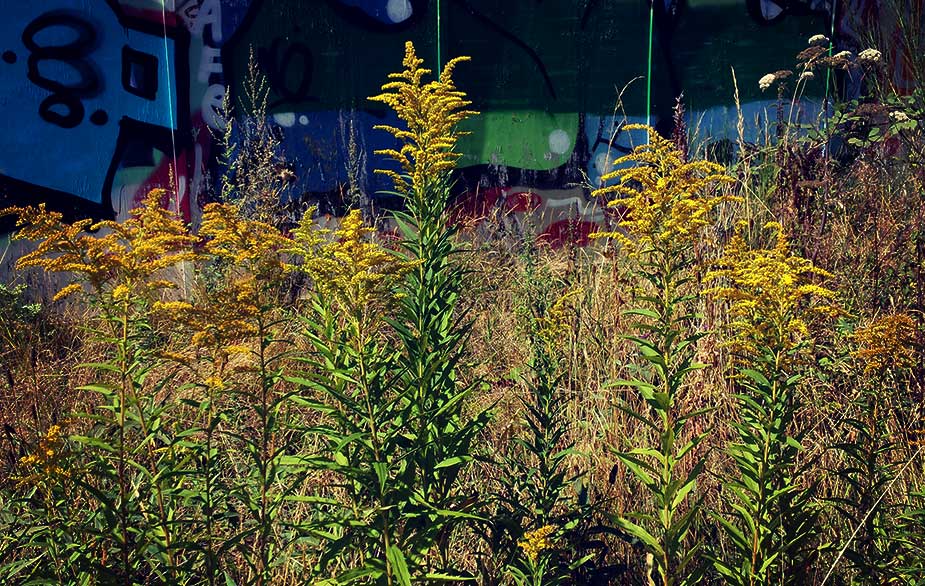
Herbaceous perennial growing upright up to 1 m. The leaves are often prominently toothed. The flowers are composed of tiny yellow rays arranged into small heads of branched pyramidal shaped inflorescences. Goldenrod often forms colonies, as it’s reproduced by rhyzomes.
Goldenrod lookalikes
Different species of Goldenrod (Solidago sp.) can be difficult to distinguish to the untrained eye, as they all have very similar bright yellow flower heads and hybridise in the wild. European Goldenrod (Solidago virgurea) is native to the UK.
It might resemble Mullein (Verbascum sp.) from afar, but flowers are much bigger than those of Goldenrod. Woodruff (Gallium odoratum) flowers are very similar, but the leaves are completely different.
All about Goldenrod
Introduced as an ornamental plant from North America, Canadian Goldenrod is now widely naturalised in England, as the plant rampantly spreads into vast carpets on riverbanks and hedgerows alike. There is also a native European Goldenrod (Solidago virguarea), which is common and widespread throughout Britain and Ireland.
Goldenrod goes unnoticed most time of the year among the green grasses until it displays beautiful yellow pyramid clustered flowers on late summer, highly attractive to bees and butterflies.
Medicinal properties of Goldenrod
Leaves and flowers have been used in folk medicine for all sorts of conditions. Some of the medicinal properties attributed to Goldenrod are analgesic, antiseptic astringent, diuretic and febrifuge. The root is applied as a poultice to burns
Culinary use and recipes with Goldenrod
There is not much you can do with Goldenrod, but flowers might look good for presentation purposes.
A medicinal tea can be made from the flowers and the leaves.
Safe foraging of Goldenrod
There isn’t enough conclusive research on the safe use of Goldenrod. Avoid if pregnant or breastfeeding.
Ecological importance of Goldenrod
It is an important food source for pollinating insects such as honeybees, bumblebees and some butterflies.