
Goosegrass: Plant profile
Common names
Cleavers, Goosegrass, Sticky Willy, Stick-a-Back, Catch Weed, Coachweed, Scratch Tongue, Garbhlus (IE)
Botanical name
Galium aparine
Plant family
Rubiaceae (Coffee)
Distribution
Native to a wide region of Europe and north and western Asia. Naturalised in many countries around the world. Common in the UK and Ireland.
Where to find Goosegrass
Hedgerows, roadsides, woodland and gardens.
When to find Goosegrass
Young leaves mid to late spring.
How to identify Goosegrass
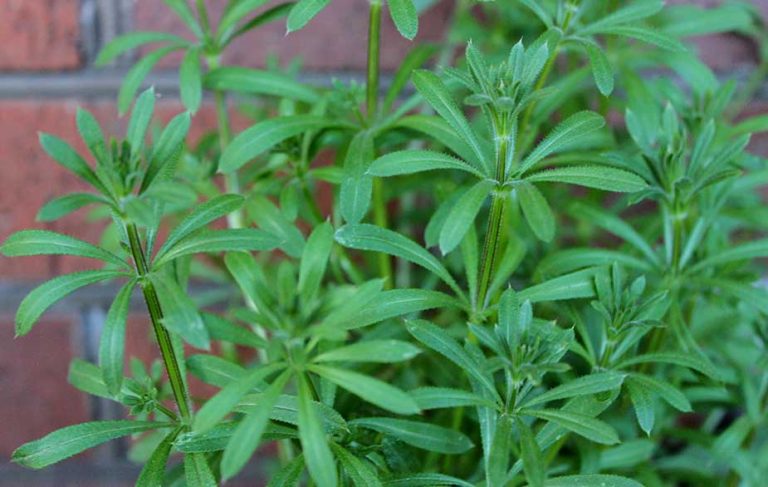
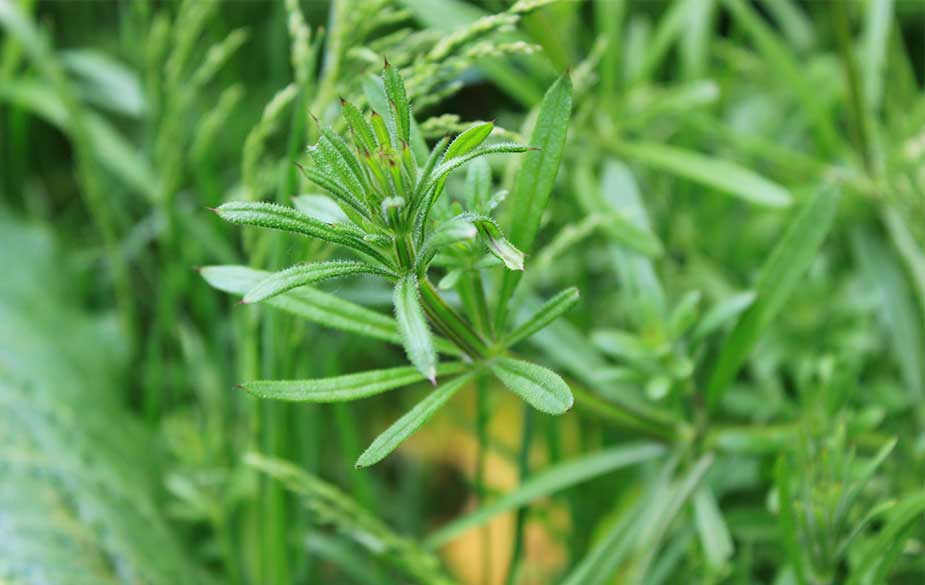
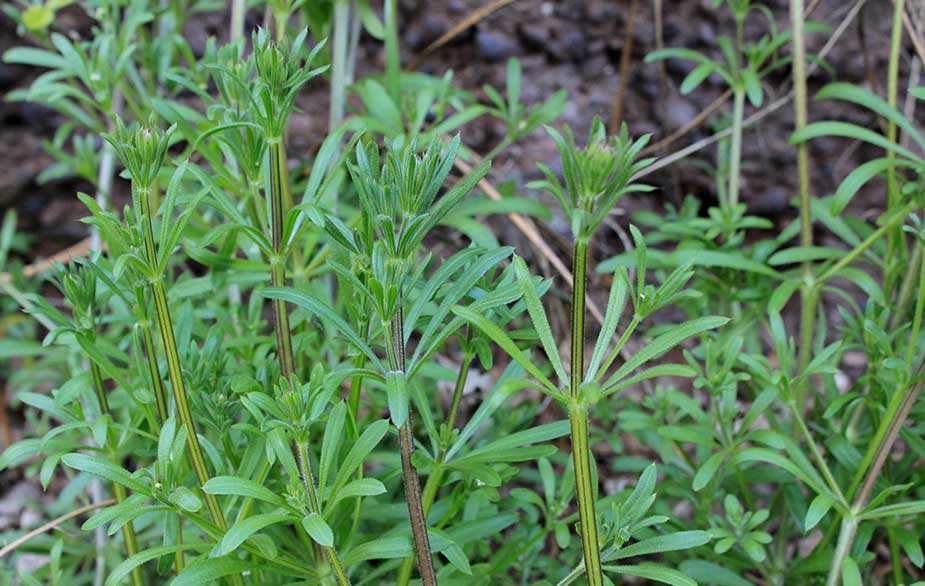
This plant is a fast-growing herbaceous annual that creeps along with straggling stems that branch out. The leaves grow in small rosettes along the vertical stem and are small, long and thin with fine hairs. The flowers are really tiny, have 4 petals and are white in colour.The seeds (which are actually a fruit) are dry, rough and covered with short hooked bristles, separating when ripe into 2 small, seeded cases. The whole plant has a square stem covered in many tiny hooks, which makes it sticky.
Goosegrass lookalikes
Other members of the same family Gallium sp., such as Woodruff (Galium odoratum) or Wall Bedstraw (Gallium parisiense) have similar leaves when young, but are easy to tell apart.
All about Goosegrass
Goosegrass is that long hairy plant, well-known amongst children that are thrown on friends’ jumpers to get it stuck on each other’s back for a laugh. It has also been a long standing enemy of the allotment owner, as their ‘sticky’ seeds easily propagate and become a sprawling nuisance in beds and borders.
Medicinal properties of Goosegrass
Goosegrass is depurative, diuretic and astringent. Take 1 cup of tea made of fresh leaves three times a day to help tackle urinary problems and alleviate the pain of cystitis. It’s also a febrifuge that helps to bring down a high temperature and reduce fever.
Apply externally to ease ulcers and wounds or treat eczema and psoriasis. Just a word of caution: although not very common, there are some reported cases of contact dermatitis in sensitive people, which causes an unpleasant localized rash and inflammation of the skin when the irritant is activated by sunlight.
Culinary uses and recipes with Goosegrass
The tender young shoot tips have a mild flavour and can be used as a convenient vegetable to bulk up spring soups, stews and pies. Wilt them in butter and use in stir fries or omelettes. Use with Nettles, Sea Beet and similar leaf vegetables.
It’s said the roasted seed produces a coffee substitute. It does make sense since Goosegrass is in the coffee plant family.
Safe foraging of Goosegrass
Cleavers may cause skin irritation to some individuals, though it’s not very common.
Ecological importance of Goosegrass
Insect pollinators may use the flowers of Cleavers sparingly.

18 thoughts on “Goosegrass (Cleavers)”
Goose grass or Cleavers, infused in water is one of the best drinks to help cleanse your lymphatic system 😀 Forage the wild plant which is good exercise and also helps clear your lymphatic system. You need 10-15 x 12”/30cm lengths for a 2 litre bottle. Wash and check, removing anything organic that isn’t Cleavers. Infuse in cold water, refrigerated for at least 24hrs, drink and reap the benefits ! Or steep in hot water for at least 20mins and enjoy hot or cold.
Thank you for sharing your recipe Jill! Such a simple, refreshing drink for spring detox.
My horse absolutely loves it & I’ve taken to stuffing a hay ball with it to keep him occupied for a couple of minutes to give me time to put his feed out. The trouble is it takes armfuls every night & I’m running out of places to find it
Maxine, I know more than a few gardeners who’d love to invite your horse over for a foraging session! 🙂
🙂 Excellent Article, Excellent Blog , Excellent Site ???
Both of our border terriers eat it, thru absolutely love it! I am sure it also helps digestive issues.
I gashed the back of my hand whilst out working in our field; the only thing available to stop the blood flowing was the nuisance weed goosegrass (which seems to be ever-proliferating no matter how much I dig up every year) – worked a treat & didn’t come off till I ripped it off later, unlike plasters!
I heard it’s full of biotin so it’s good to add to animal feed if they’ve hoof or nail issues. One pony eats a lot of it fresh so I assume he knows its beneficial (?)
One of my dogs used to eat a lot of goosegrass. I wonder why. Another used to eat green alkanet. Another dog’s mercury – although I was told this was poisonous it seemed to do him no harm.
This also has another colloquial name- For at least the past 40 years since I was a kid this has been locally known as ‘sticky weed’, at least on the Wirral and in North Wales.
Didn’t know you could have it in omelette though, will give that a try!
When you say ‘apply externally’ what does that mean? Fresh, mashed up, after boiling…
Hi Katherine,
It depends. A pad soaked in a goosegrass infusion can be good to ease skin ulcers and inflammations, a cream treatment is best for psoriasis, etc.
I would recommend you talk to a herbalist for qualified and comprehensive advice.
My dog loves it.
Yes mine does too
Lol, that’s why I was reading about it, it is a favourite of my son’s dog, I was checking to see if it was safe for her, mind you, she’s had quite a bit and nothing untoward has happened!